Behaviour as Structure
Notes on generative systems for exhibition contexts. The criteria PROJEKTA2 applies to author works and living systems, written for curators, registrars, technical teams and collectors.
Alexandre Iglesias · PROJEKTA2 · Costa Brava (Girona, Spain)
1. Introduction
Here, a generative system is a set of rules and relationships that produces a result not fixed in advance and that keeps a state over time. These are not images generated once and archived, but processes that run in real time while someone is looking at them.
That difference has practical consequences. A still image is lent, installed and conserved as a file. A system that responds and changes requires decisions on how it behaves, when it is reset, what equipment runs it and what documentation goes with it.
This text is neither a catalogue nor the defence of a trend. It sets out the technical and artistic decisions the studio has already made and the limits it accepts, so that anyone assessing an acquisition, a commission or a loan has concrete criteria.
PROJEKTA2 works along two lines that should not be confused:
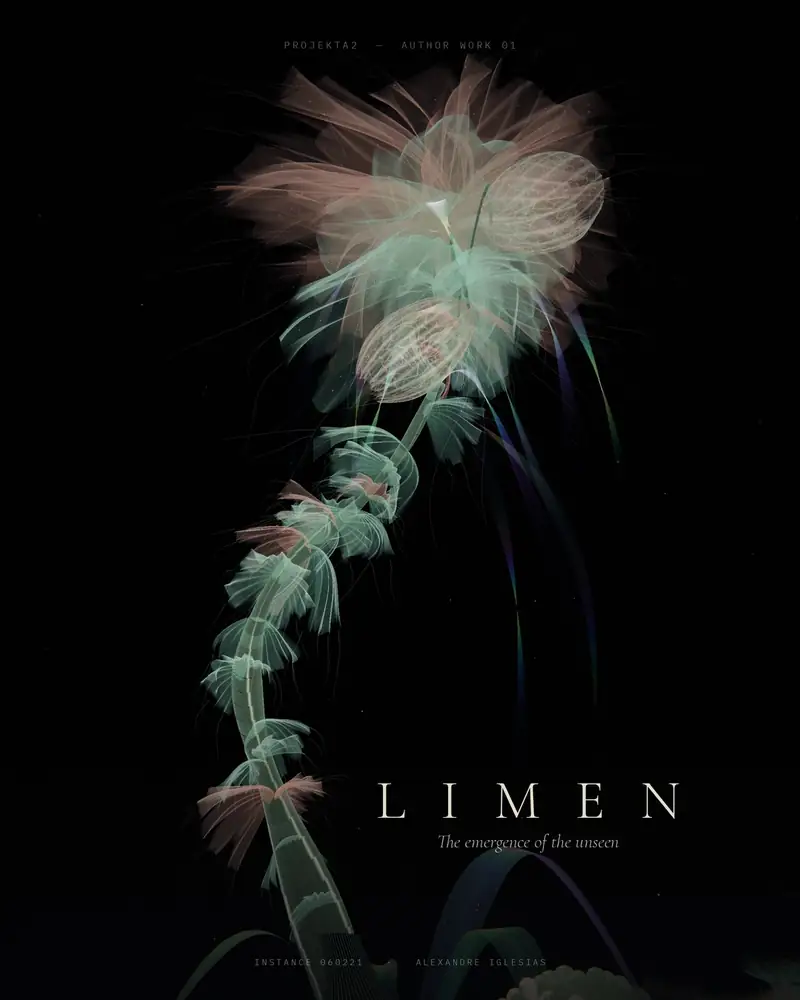
- Author works by Alexandre Iglesias: closed pieces, in a 1/1 edition (the Kintsugi Digital series: Kintsugi I, Wabi and Yūgen) or with a collector edition and a museum installation (LIMEN, which opens Trilogy II).
- Living systems: studio systems designed or adapted for a specific space, on commission.
2. Behaviour as structure
In these works, behaviour is part of the work: it is not a visual effect added on top of an image. Two kinds of system help to explain it.
| A system that reacts | A system that changes state | |
|---|---|---|
| What interaction does | Triggers a temporary response | Modifies the system's configuration |
| What happens next | The system returns to its starting point | The system continues from the new state |
| Role of time | Neutral: each gesture is spent in itself | Cumulative: what happened conditions what follows |
| What is documented | The expected response | The response, the state and the reset conditions |
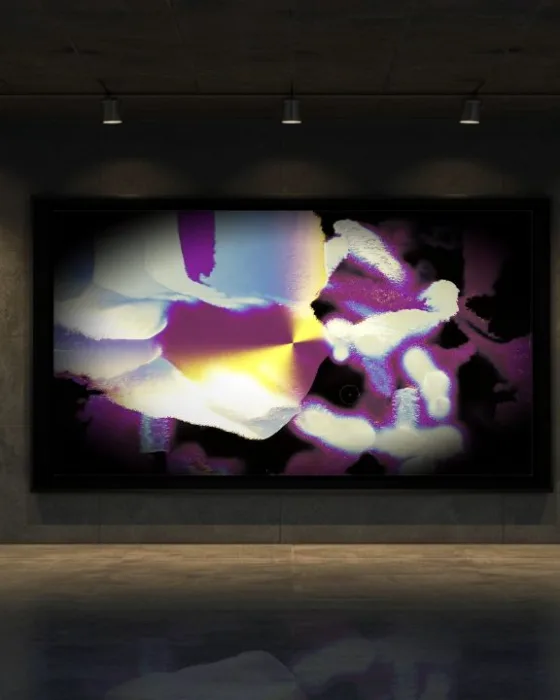
The works in the Kintsugi Digital series belong to the second kind. During a session, what visitors do modifies the work and cannot be undone: in Kintsugi I the surface fractures and the cracks fill with light; in Wabi presence leaves a trace; in Yūgen two states coexist. The system offers no undo.
That irreversibility is not an effect. It is a rule of the work, of the same order as its palette or its geometry. Its direct consequence is that the time of the session and the visitors' actions become material of the piece.
The studio's living systems can be designed either way. Some react to gesture, sound or presence and return to a base state; others accumulate what happens over the day. Which one fits is decided with the venue, according to its audience and intended use.
3. Implications for the exhibition context
When interaction leaves a trace, resetting stops being a technical detail and becomes a curatorial decision. Before opening to the public, the start and end of a session must be defined.
Reset policy. The studio agrees it with each venue and records it in the installation sheet. The usual options are:
- Reset per session: each visitor or group finds the work in its initial state.
- Daily reset: the work accumulates the day's activity and returns to its initial state at closing time.
- Reset per period: the work accumulates over a defined stretch of the exhibition, with dates recorded.
Each option produces a different reading of the same piece. None is neutral, which is why it is not left to chance on the gallery floor.
Documentation. Each piece's sheet describes the expected behaviour, which visitor actions modify the state, how it is reset and what counts as correct operation. With it, a technician who does not know the work can verify that it is properly installed.
Interpretation. Visitors do not only watch: they act on the current state of the work. The label should say so clearly (what can be done, and that it cannot be undone) so that participation is deliberate rather than accidental.
Conservation. What is conserved is not an image but a system and its rules: the work's file, its documentation and the conditions to run it. The work can be shown again in the future as long as those three things are kept.
4. The living system as a self-contained package
Every piece by the studio, living systems and LIMEN included, is delivered as an exhibition package that runs without an internet connection. It is a technical decision that answers a real problem for venues: a work that depends on an external server stops working when the network fails, a service changes or an account expires.
| Item | What it is for |
|---|---|
| Local application | Runs the work on the venue's computer, with no online dependencies |
| Fallback version | Restores the work if the computer or the main installation fails |
| Technical installation documentation | Describes equipment, connections, start-up, reset and verification |
| Behaviour sheet | Explains what the work does and how to tell that it works as intended |
| Source code (commissioned living systems) | Ensures the system can be maintained over the long term |
What a living-system commission includes. Design of the system for the space, technical development (real-time response and, where needed, sensors and audio), installation and on-site calibration, source code and documentation, and 12 months of support. Commissions start at €9,500; the final budget depends on scope.
What adapts and what does not. The system is adjusted to the scale of the space, the type of screen or projection, ambient light and visitor flow. The behavioural logic is defined before installation and fixed in the documentation, so the venue knows exactly what it receives.
5. Reference technical requirements
The works run in real time (WebGL) on the venue's computer. The table summarises the reference configuration the studio uses as a starting point; the final values for each piece are set out in its documentation and reviewed with the technical team before installation.
| Component | Reference configuration | Notes |
|---|---|---|
| Computer | A machine dedicated to the work, with a recent dedicated graphics card | Not shared with other applications during the exhibition |
| Display | Screen or projector with a minimum resolution of 1920 × 1080 | 4K is recommended for large formats or close viewing |
| Interaction | Mouse, touchscreen or sensors, depending on the piece | The interaction mode is part of each work's sheet |
| Audio | Only for pieces that use it | Speakers or headphones, depending on the venue |
| Network | Not required | The work runs offline |
| Operation | Automatic start-up and full screen | Gallery staff switch it on and off without technical help |
Before installation. The studio and the venue review together the available equipment, location, light and visitor route. If the venue's equipment does not meet the reference configuration, the studio states what to change or adjusts the piece where possible.
During installation. For acquired author works, the artist supervises the first installation. For living systems, installation and on-site calibration are part of the commission.
Verification. The installation is signed off when the work starts on its own, behaves as its sheet describes and resets according to the agreed policy.
6. Traceability and rights
Each 1/1 author work is delivered with documentation that allows it to be identified, verified and exhibited without ambiguity.
| What the buyer receives | What it is for |
|---|---|
| Numbered and dated certificate of authenticity | Attests the work and its edition; it can be verified online at projekta2.com/verify.html |
| Cryptographic fingerprint (SHA-256) of the file | Uniquely identifies the delivered file: any alteration changes the fingerprint |
| The work's file and installation documentation | Allow it to be run and reinstalled in the future |
| Perpetual exhibition licence | Authorises showing the work, in the private or institutional scope set by the contract |
| The artist's supervision of the first installation | Ensures the work is installed as intended |
| Contract with the usage rights | Sets out in writing what can and cannot be done with the work |
What is transferred and what is retained. The buyer obtains the work and the right to exhibit it. The artist retains the intellectual property and moral rights. The contract does not transfer the right to modify the work, distribute copies or create derivative works.
Why it matters. This documentation travels with the work if it is lent, donated or changes hands. A registrar can check that the piece received is the one named in the certificate.
Loans and commissions. For exhibition loans, the conditions of display, reset and credits are agreed in writing with each institution. For commissioned living systems, licence and uses are defined in the project contract.
7. Decisions and limits
A well-conceived generative system has clear limits. These are the studio's.
- No fixed image is guaranteed. What is guaranteed is a system with defined and documented behaviour. What appears on screen varies by nature.
- No templates are delivered. Each living system is designed or adapted for its space; none is reused without adaptation.
- Author works are not modified on request. Their rules, including irreversibility during the session, are part of the work. What is agreed with each venue is the reset policy, not the behaviour.
- Not every project needs sensors. Some systems respond to gesture or sound; others evolve with time alone. The choice follows what the space and audience require, not what is most complex.
- The result also depends on the space. Equipment, light, visitor route and daily maintenance shape how the work is perceived. That is why they are reviewed before installation.
- No reliance on external services. No piece needs internet, platform accounts or third-party servers to run in the gallery.
- Every proposal is assessed before it is accepted. The studio studies the space, the audience and the aim of the project, and only takes on commissions in which the system can work as intended.
8. Closing note
These criteria apply equally to author works and living systems: behaviour is defined, documented and delivered so that the venue can maintain it without depending on the studio.
A specific project (acquisition, loan or commission) starts with a conversation about three things: the space, the intended use and the technical conditions available. From there, the studio sends the documentation of the piece or a proposal for the system.
Contact. [email protected] · Information for museums, galleries and curators · Dossier and availability